Encyclopedia Politica
Services
UI/UX
Client
Spread The Vote
Tools
Figma, FigJam
Year
2025
Summary
Encyclopedia Politica is a database that provides information on all governmental roles— from local to federal— across the U.S. in a friendly, interactive platform. Through this website, users will be able to learn more about their government, have access to the most niche roles in their region, and have a guide to run for office.
Info
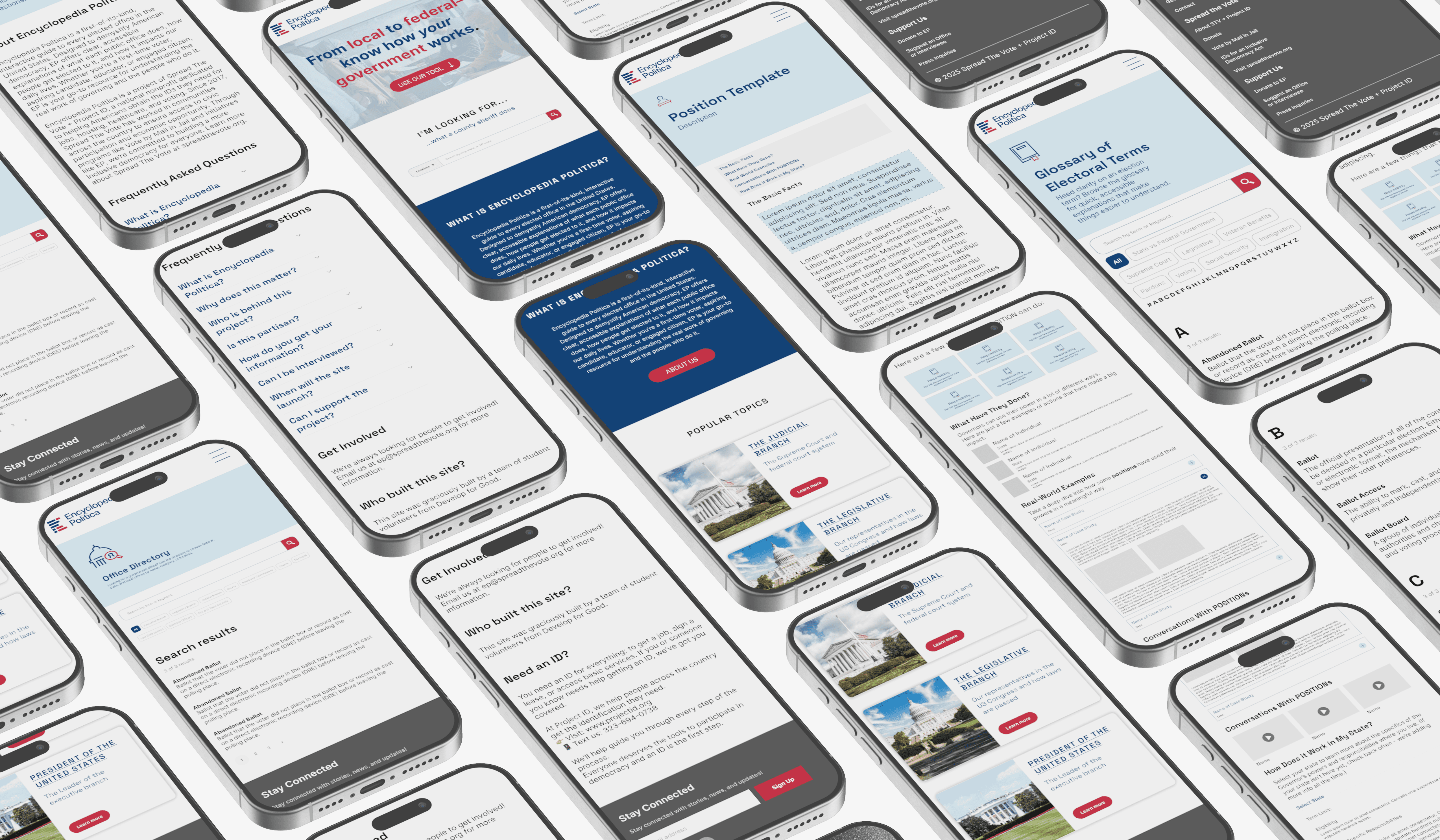
A searchable directory on all elected official roles, from federal to local, throughout the U.S; I led user research and information architecture decisions, while auditing pre-existing design assets based upon web accessibility and design standards. (Role: Design Manager/Designer, conducted user research and designed wireframes)
Case Study: Designing a Comprehensive Digital Guide to U.S. Governance
Overview
Spread The Vote is a nonprofit that empowers both low-informed and new voters through friendly, accessible resources. They strengthen communities through advocacy initiatives like Project ID, Read The F*ing Directions, along with Encyclopedia Politica.
“I am so impressed with Develop for Good. The team was professional, responsive, timely, and most importantly, did an excellent job. I would use them again for every project.”
- Kat Calvin, Founder and CEO of Spread The Vote
Problem
Voters across the country lack information in who works in their governmental structure. Whether it's for understanding the political structure of their municipality, researching a specific commissioner, or interested in running as a candidate, there is no consolidated platform in which one can access information on elected officials in all levels of government throughout the country.
Challenges
Ambiguous scope, lack of assets and research data
How do end users prefer/need to navigate the website?
What are the pain points contingent to causing confusion on a politically informative website?
Reflections
I defined the site’s information architecture, identified and tested failed user flows, and built foundational wireframes to support a scalable civic information system. I also audited brand guidelines for web accessibility and developer handoff, and created, conducted, and synthesized multiple rounds of user research. With more time, I would have expanded usability testing and longitudinal research to further validate and refine the navigation model.
Process
Encyclopedia Politica's journey began by identifying project criteria. Our goal was to create a friendly, engaging website that made condensed political information comprehensible and nonthreatening to a low-informed voter (while also being informative enough for a prospective political candidate). In addition, our aim was to provide a universal, modular template designs for each electoral role, one that could be applied in a low-code content management system. The assets and research weren't readily available, meaning our team had to understand a systematic approach of the political structure. This also begged the question as to how a user mentally maps out governmental structure:
The main challenge was understanding how to connect the user's mental model and pain points of the civic system and how that translates into a user navigating an in-depth political database.
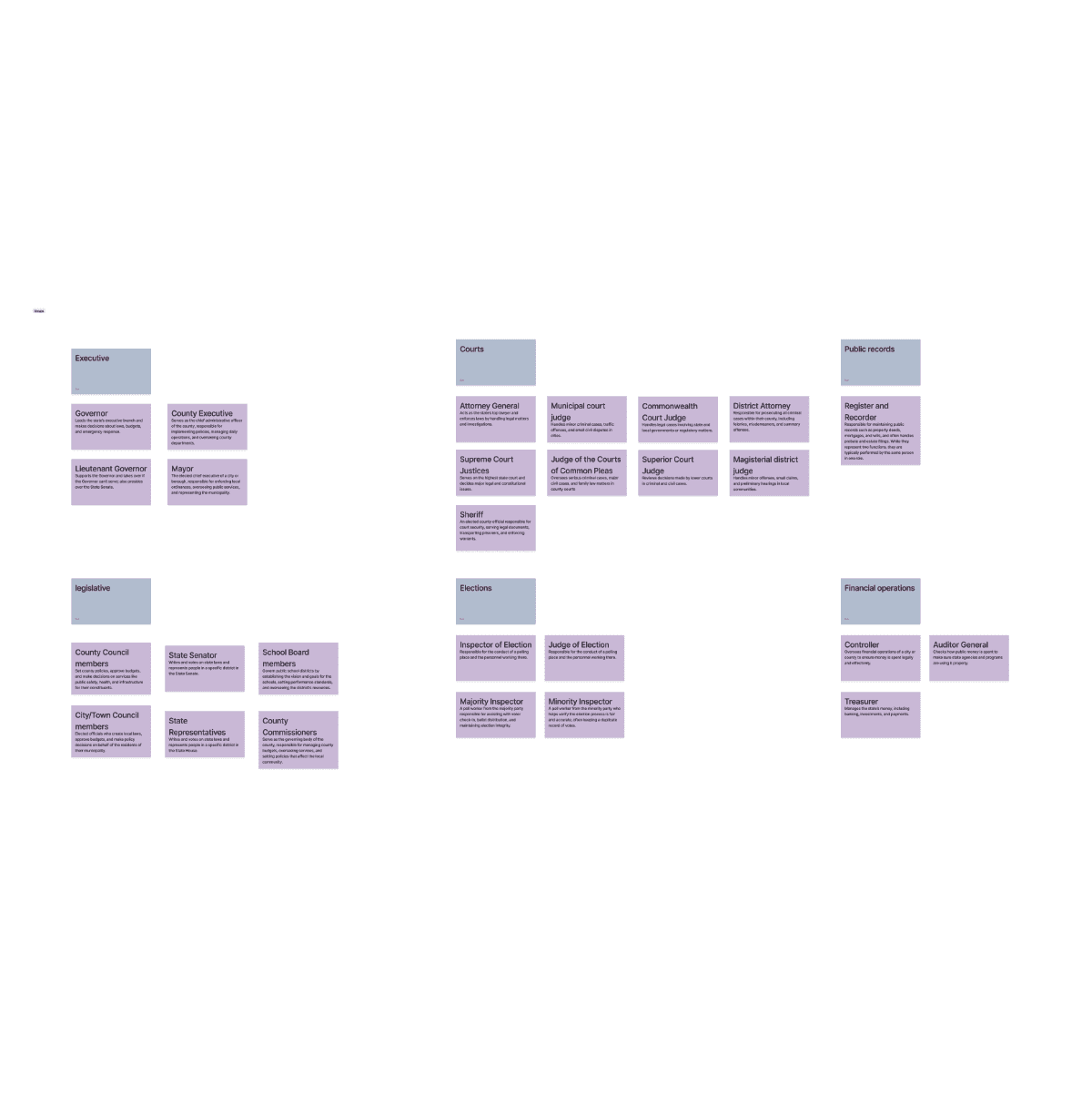
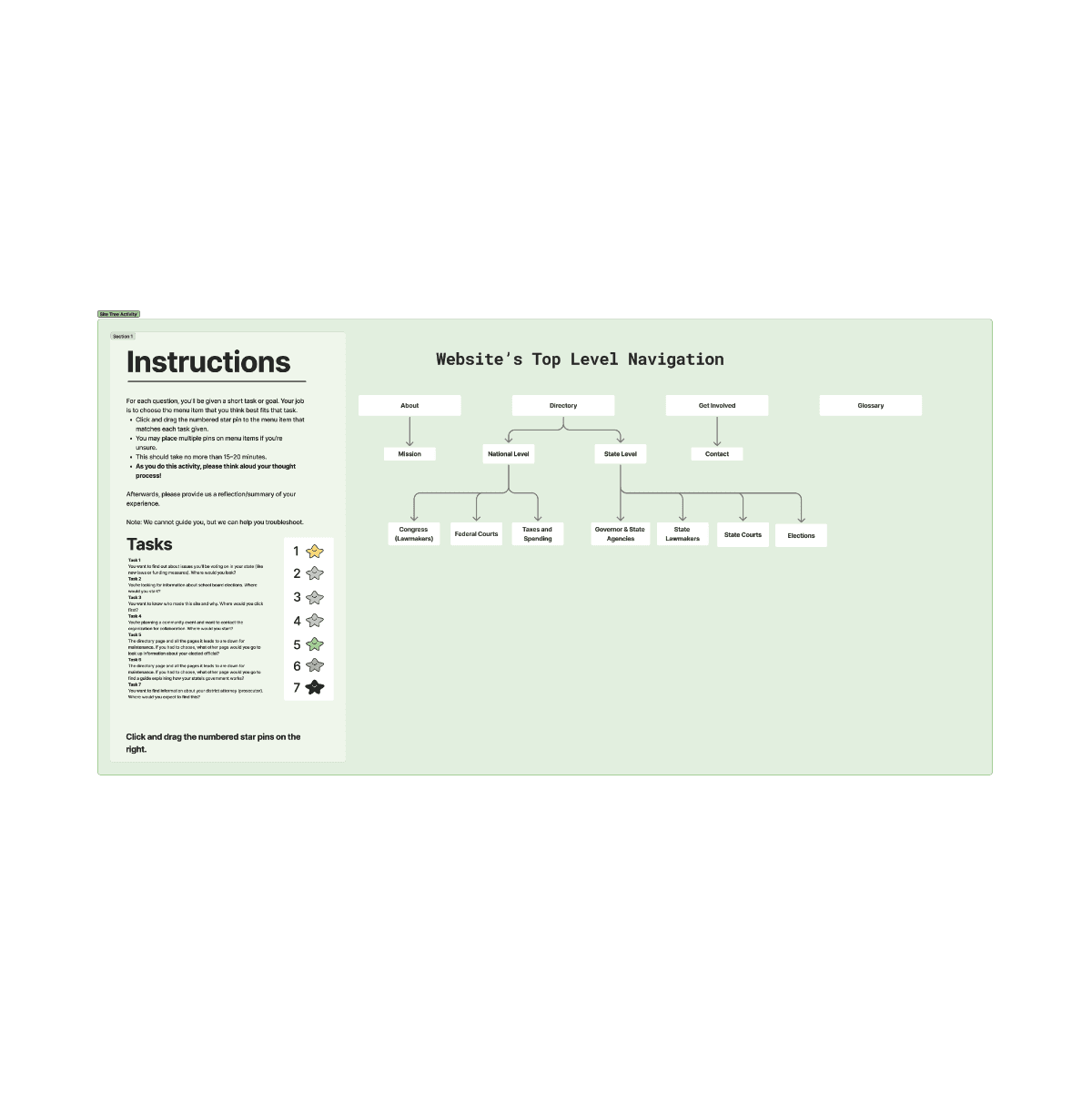
In order to understand the navigability of the site, I led and conducted three rounds for user research: user interviews, open card sorting, and tree-testing. Through this data, our team learned that 3/5 users sorted the offices into categories based on the "type of role" they are (executive, court, financial, law enforcement, etc). As tree-testing was conducted, we realized that individual user's mental models (from low-informed, to political candidates) overlapped, thus resulting in the discovery of the main user flow issue— government scalability and structural overlap. Political labels and roles are inconsistent, both vertically and horizontally, throughout local and national structure. Although political sites provide rigid, detailed information, we needed a site flow that provided fluidity and flexibility for user action.
Synthesizing the qualitative data, I advocated for the implementation of a search bar with categorical filters as the primary feature, which simplified navigation and directly aligned with client/stakeholder priorities. This is only the beginning for Encyclopedia Politica. It is being updated with revisions to further Spread The Votes's goal.